Short on time? Get the key takeaways in ChatGPT →
Somewhere in the last year, it seems like every marketing newsletter in your inbox started speaking a different language, right??
AEO. GEO. LLMs. AI Overviews. “Getting cited.” Everyone is suddenly using these terms, but nobody stops to define anything!
If you’ve been nodding along, but secretly feeling a little lost, I want you to know you’re not behind, and I’m here to catch you up.
We’re going to start at absolute zero and build up from there, until you understand exactly what AI is (in the context of marketing and online business), how it impacts the way you reach your audience, and how to harness AI to your advantage moving forward.
What is “AI”? (And what’s an LLM?)
When people say “AI”, they’re almost always talking about AI chatbots, aka tools like ChatGPT, Claude, and Gemini.
You type a question, and unlike Google, you don’t just get a list of links to explore.
Instead, the AI chatbots just answer you directly. Like a very fast, very smart assistant wrote a little research brief, just for you. (It still blows my mind that this is possible.)
This is why you’ll hear these tools called “answer engines” or “generative engines.”
A search engine (classic Google) finds existing pages and ranks them. These AI tools generate a brand-new answer, just for you.
All AI chatbots are powered by large language models (LLMs).
LLMs are programs trained on massive amounts of text, including much of the internet. They understand language so thoroughly that they can explain almost anything conversationally.
Each AI chatbot runs on its own underlying models. ChatGPT is powered by OpenAI’s GPT models, while Claude runs on Anthropic’s models (with names like Fable, Opus, and Haiku). Companies usually offer a few versions that trade off speed, cost, and intelligence.
But… even though it may feel like AI tools are providing information themselves… every single thing the LLMs “know” came from somewhere.
Potentially even your own website!
And understanding this connection is the key to AI visibility in this new era.
How AI changed the way people search (and find you)
In the “old days”, when people wanted to find something, they searched Google, a list of links came up, and they clicked through to various websites.
Now, AI has interrupted organic search in two separate places, with different rules for optimization.
First, Google added AI answers directly to search
Google still gets billions of searches a day. However, what people see after they perform a Google search has changed significantly.
AI Overviews (formerly called “search generative experience (SGE)”) were added to the search results in 2024.
An AI Overview (AIO) is an AI-written answer that sits above what used to be the #1 spot in the search results.
I guarantee you’ve seen these when using Google, even if you never knew what they were officially called.
For example, if you search “is pineapple high fodmap”, the first thing you see is an AI Overview that answers your question, with a few sources linked directly within the response and in the right-hand sidebar.

Would you like to save this?
The traditional search results are still there, but they only appear underneath this AI response box.
And in the food/health/nutrition space, there are a few patterns to notice:
- AI Overviews show up most on “informational” searches, where there is a clear consensus answer to provide. Think things like “is oat milk good for you,” “how much protein do I need at breakfast,” “why did my sourdough fail”. Unfortunately, this is exactly the type of content a lot of SEO-optimized food and nutrition blogs were built on. That’s why creators in our corner of the internet felt this shift earlier and harder than other niches.
- Health content is filtered extremely carefully by Google. They’re far pickier about what sources they quote on nutrition and medical topics than on, say, travel tips. This makes it more difficult to show up inside the AI Overviews for topics that can impact someone’s health (including nutrition), but if Google is going to cite anyone, they’d prefer to point people to real experts who have lived experience and expertise in their niche (and that could be you!)
- Recipe blogs are somewhat insulated from AI, for now. If you search for a recipe in Google, you probably won’t see an AI Overview at the top of the search results. Google is still showing classic recipe packs in the search results, so food bloggers have not been disrupted by AI Overviews in the same way that informational bloggers have been.
The second big shift is that you can navigate directly to an AI chatbot inside Google search
If you expand the AI Overview by clicking “show more”, you can read the whole AI answer, followed by an “Ask Anything” box below:

That “Ask anything” box is where you can submit follow-up questions and enter Google’s “AI Mode”, directly through the search results interface.
AI Mode functions like other AI chatbot tools (ChatGPT, Claude, etc.), where you can have back-and-forth conversations with context, and receive your answers without ever seeing a traditional search results page at all.
(You can also access AI Mode by clicking the “AI Mode” tab at the top of Google search.)

So there are now two ways to access AI directly within the Google search results: AI Overviews and AI Mode.
The easiest way to keep them straight: an AI Overview is a concise answer box at the top of the traditional organic search results; AI Mode is a full-on AI chatbot that can hold conversations outside of the traditional search interface.
AI Overviews vs AI Mode
Here’s a quick comparison of how AI Overviews and AI Mode work:
|
|
AI Overview |
AI Mode |
|
What it is |
A concise AI answer box |
A full AI chatbot inside Google |
|
Where it appears |
Top of the normal search results |
Its own tab / the “Ask anything” box |
|
Format |
One summarized answer with source links |
A back-and-forth conversation |
|
The results page |
Still there, pushed down |
May never appear at all |
Some people speculate that AI Mode may be the future of Google search, but as of right now, we have this hybrid of the old and new.
It does appear that AI Mode is gaining traction though, with over a billion people using it monthly, as of May 2026.
AI Overviews and AI Mode answer questions differently than Google
There is another critical difference between how traditional Google search works and how AI responses are created.
When you ask AI something, it doesn’t just run one search based on whatever you literally typed in.
Instead, it splits your question into a whole batch of smaller searches, runs them all at once, and builds the answer from everything it finds.
The industry calls this query fan-out, and it changes the way you need to create content to comprehensively serve your audience and increase your odds of getting included in AI answers.
Do AI Overviews and AI Mode cite the same sources?
Another super interesting aspect here is that AI Overviews and AI Mode almost always cite different sources in their responses.
One large Ahrefs study compared AI Overviews and AI Mode across 730,000 answers and found they cite mostly different websites, with only about 14% overlap.
This can make optimization a little tricky, but it also means there are 2x as many potential places your brand and your content could appear!
So to sum it up, Google knows that most people are still going directly to Google search when looking for something, so they found two ways to integrate their AI products into the search experience directly.
What is the difference between AI Overviews and AI Mode?
An AI Overview is the concise AI answer box at the top of a normal Google results page. AI Mode is a full chatbot experience inside Google where you can have a back-and-forth conversation and may never see traditional results at all. Studies show the two cite mostly different sources.
The elephant in the room is that some people skip Google entirely and go to AI chatbots directly
There’s a smaller (but growing) subset of people who may no longer go to Google at all when they’re looking for something.
They open ChatGPT and ask their questions directly, like, “what should I eat before a morning run?” “how do I start a food blog?” or “who are the most trusted experts on gut health?”
The chatbot builds its answer from two sources, blended together:
- What it remembers from training. Every model carries a memory of the internet it was trained on. This is where being a known name in your niche pays off. If your name kept showing up next to your topic all over the web, the model learned that association, and it can impact whether your brand is mentioned or cited.
- What it finds by searching live. For anything recent, the chatbot runs a real-time web search to pull the freshest information. This is where traditional SEO interacts with AI optimization, by getting you into the pool of sources the chatbot pulls from.
As you can see, getting cited or mentioned directly inside an AI chatbot is a more complex game than just trying to rank on Google or get mentioned inside an AI Overview.
And to complicate things further, each AI tool favors different sources of information when compiling answers, making AI optimization quite the challenge!
So ideally, you’ll keep track of how you’re performing in all the AI surfaces separately. Google the key topics in your niche and see what shows up in the AI Overview, then ask those same questions directly in the various AI chatbots and see how the responses differ.
(Do this in an incognito window or when you’re not logged into an AI tool so that your own behavior does not impact the responses.)

Why AI search matters for your online business
If you run an online business built on content, you need to pay attention to AI optimization.
For fifteen years, the deal was simple: publish helpful things, rank in Google, get the click, earn the reader, make the offer.
But now a good portion of your audience gets their answers directly from AI, without clicking to your website.
In fact, Pew Research found that people clicked through to websites from Google about half as often when an AI summary was present, and clicked the summary’s source links only rarely.
If your traffic to informational blog posts has gone down recently, AI is likely a big reason why. The search landscape just underwent a monumental change.
I may be a glass-half-full type of person, but I prefer to figure out ways to harness this change to our advantage, rather than dwell on how it has negatively impacted content creators.
The truth is, AI is great at summarizing “known” information. But it has to get that information from somewhere, so you might as well learn how to position yourself as the best source.
Once you make that mental switch, the goal is no longer to just drive traffic to your website, but rather, to become the source an AI answer is built from.
And luckily for us, this new question uniquely rewards people who can generate novel data, opinions, and perspectives, based on their lived experiences and expertise.
It rewards real humans who have something unique and genuinely valuable to say. Because truly, AI has no use for the thousandth generic article that rehashes the same information as 200 other sites.
The big shift: Google ranked pages… AI assembles answers from passages
If you remember one concept from this whole post, make it this one: Google ranked pages. AI assembles answers from passages.
Picture a freelance writer putting together an article for a digital magazine. She pulls a quote from a dietitian, a stat from a study, a practical tip from a blogger she trusts… and stitches together one article out of many voices.
AI creates content the same way, on the fly, millions of times a day.
Here’s how the shift from ranking to citing can impact your visibility
Say you have a zucchini bread recipe on your site, and buried in the middle of your post is an incredibly clear explanation of why zucchini bread can come out soggy: you have to wring the water out of the shredded zucchini, and you explain exactly how and why.
- The old game: Your recipe post would likely rank in Google when someone searched for zucchini bread recipes, but if someone looked up why their zucchini bread was soggy, an informational blog post about this specific topic would likely outrank your recipe, because the post as a whole was a better match for what that searcher was looking for (search intent).
- The new game: AI sees your beautifully crafted direct answer to the question, buried inside your recipe post. Rather than analyzing how relevant your entire post is to the query, the AI can simply lift that one extremely relevant section of your blog post, summarize it inside its AI-generated response, and link to you as the source. Now you are being seen as a relevant expert on this topic within the AI response, even if your zucchini bread recipe never showed up in the top 10 results in a regular Google search for the topic.
The old SEO game involved whole pages competing for slots in the search results. The new AEO game involves passages competing to be quoted within AI responses. This means different rules and different winners.
AEO vs SEO: A Quick Comparison
Here’s a quick comparison of SEO and AEO differ:
|
|
The old game (SEO) |
The new game (AEO) |
|
What competes |
Whole pages |
Individual passages |
|
The goal |
Rank in a list of links |
Get quoted inside the AI answer |
|
Who wins |
The page that best matches the query |
The clearest self-contained explanation, from a trusted source |
|
The metrics |
Rankings, clicks, pageviews |
Citations, mentions, branded searches, AI referral traffic |
|
Your job |
Optimize the entire page |
Optimize each section of the page |
What does “winning” look like now? (AI citations, AI mentions, and the new KPIs)
There are two ways you can benefit in this new world of AI answers.
You can earn a citation and/or a mention. They’re earned in completely different ways, and ideally, you want both.
Let’s dig into AI citations and AI mentions a little more, one at a time:
An AI citation is when an AI answer links your site as one of its sources.
Citations look a little different depending on which platform you’re using, but for topics that require current information from the web, most of them will include links directly within the AI answer, showing which source each piece of information came from, as well as a full list of all sources referenced.
Example of a citation inside ChatGPT:
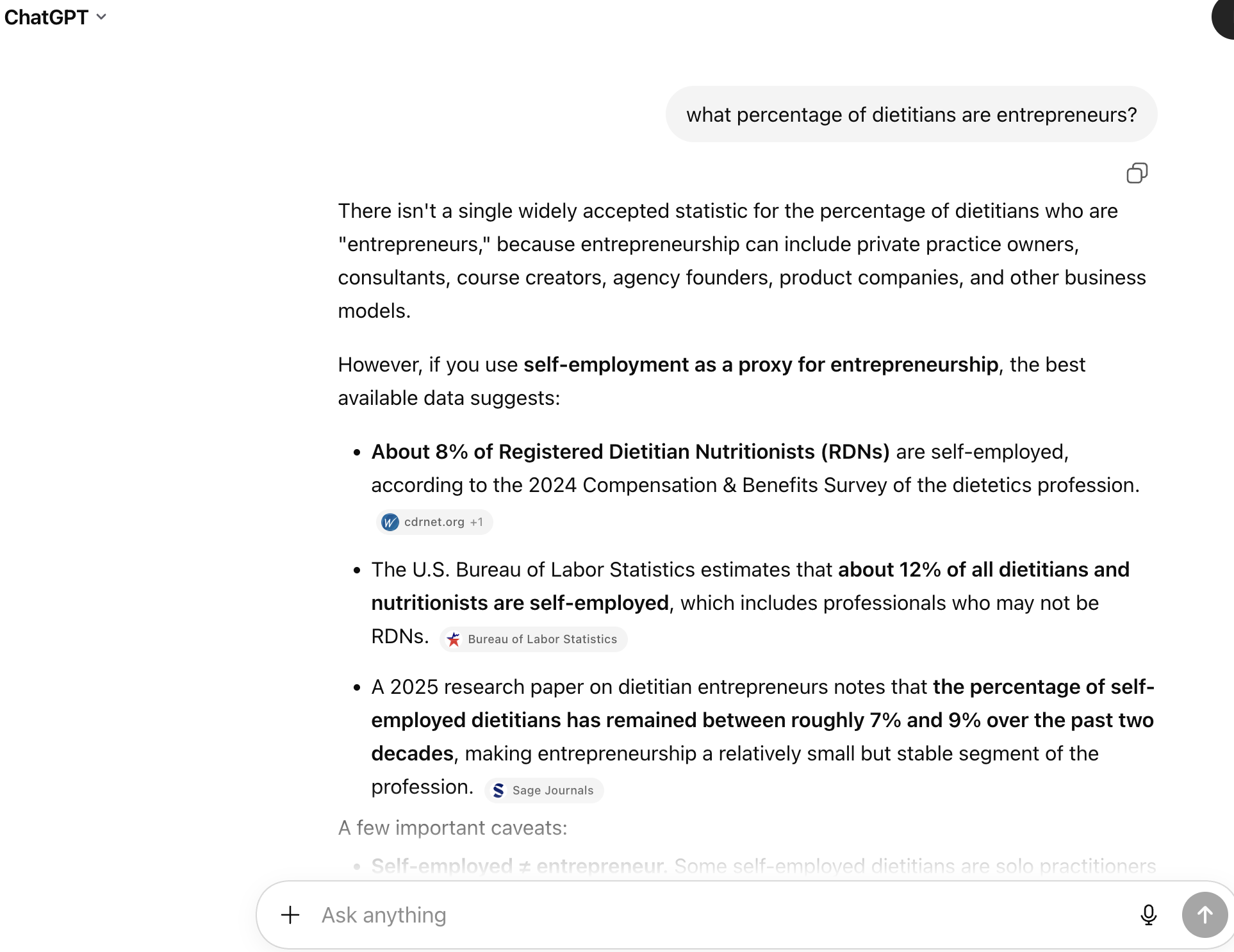
Citations are earned by your content. To be chosen, you want clear, self-contained answers the AI can lift cleanly, and your site needs to be easily accessible by AI crawlers.
An AI mention is when an AI answer mentions you as a go-to resource, with or without a link.
Example of a mention inside ChatGPT:
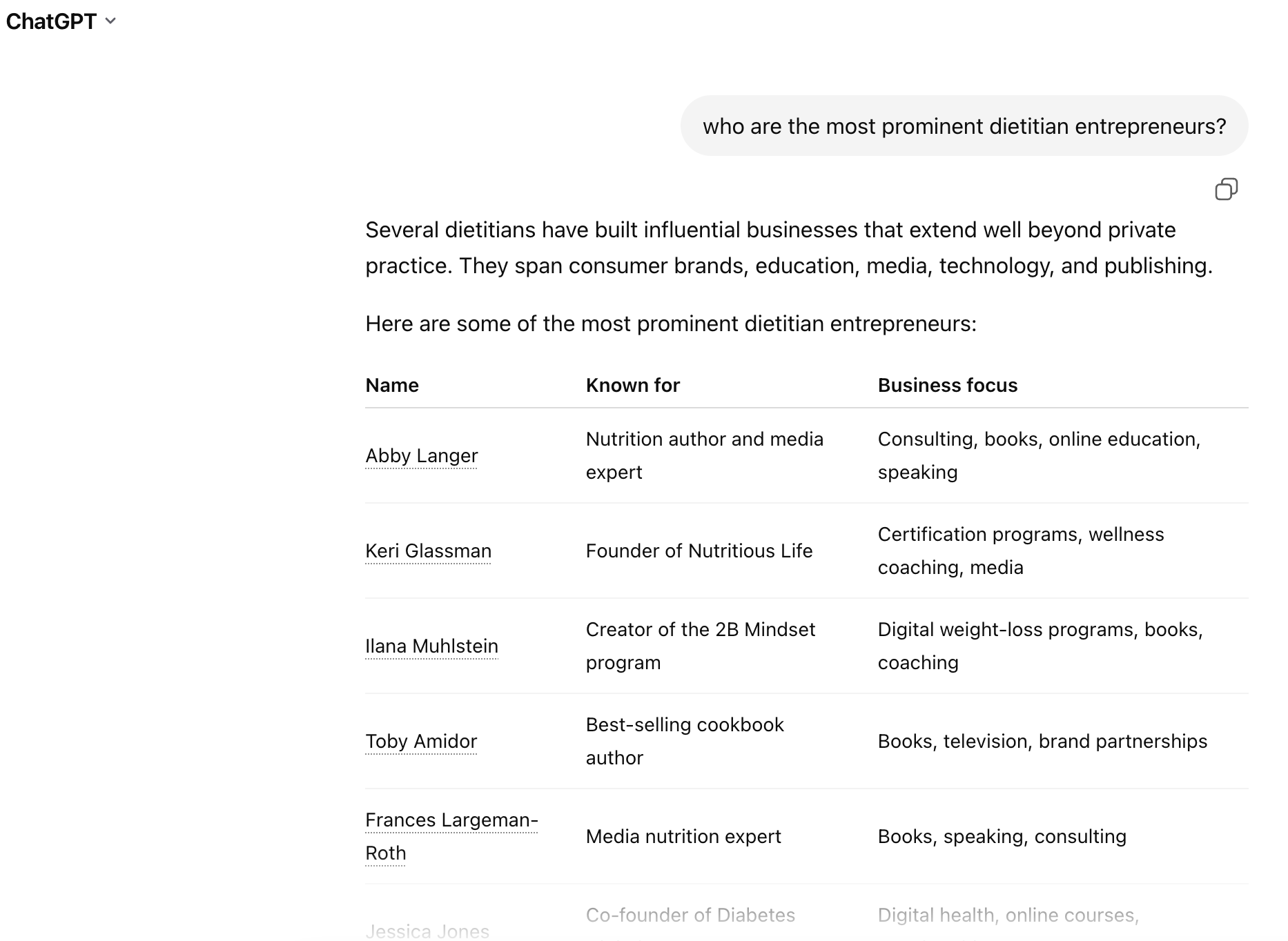
Mentions are earned by your reputation. The AI models learned who’s who by reading the whole internet… so the more your name shows up near your topic out in the world (other people’s posts, podcasts you guested on, Reddit threads, press), the more the AI associates you with that topic and names you unprompted.
In this example from Google’s AI mode, you can see both AI citations and AI mentions in the response:

AI Citations vs AI Mentions
Here’s a quick rundown of how AI citations and AI mentions compare:
|
|
AI Citations |
AI Mentions |
|
What it looks like |
The AI links your site as a source |
The AI directly names you or your brand, link or no link |
|
Earned by |
Your content |
Your reputation |
|
How to get more |
Clear, self-contained answers on a crawlable site |
Show up in niche-relevant content everywhere: podcasts, press, Reddit, other people’s posts |
|
How to check |
Ask AI tools questions in your niche |
Ask AI tools “who should I trust on [your topic]?” |
To increase your citations and your mentions, you need to make your content easier to quote, and make your name harder to avoid.
Even more critically… your brand could experience great visibility within AI tools without seeing much traffic.
So instead of just looking at traffic to our websites, we also need to pay attention to things like:
- Are you cited when the AIs answer questions in your topic?
- Are you mentioned when someone asks “who should I trust on this?”
- Is your branded search growing? People who see your name in an AI answer often Google you later. That shows up as more people searching for your name or your brand name.
- Is AI referral traffic appearing in your analytics? Visits from ChatGPT or Perplexity may be small numbers today, but they’re usually extremely warm leads since the AI already introduced you.
Okay, so now that you understand what AI is and why it matters for online business owners and content creators, let’s wrap this up by defining some of the acronyms you might see flying around online.
So what is AEO? (And GEO, and the rest of the acronym soup)
AEO (answer engine optimization) is the practice of making your content easy for AI tools to find, understand, and pull from when they write an answer.
AEO builds on top of the SEO (search engine optimization) you already know.
Having a fast, well-structured, crawlable site, clear, organized writing, and demonstrating real expertise and firsthand experience is all still critically important.
You are not starting over. If you’ve done SEO for years, you’re standing on a super solid foundation; there are just a few new layers you need to build on top.
Now, you might have seen a few other related acronyms out there… but most of them are just competing names for the same thing. The industry has been arguing about what to call it for three years and still hasn’t picked a winner.
Here are the most common names for AI search optimization:
- AEO (answer engine optimization) is the oldest of the bunch… it predates ChatGPT and originally meant optimizing for featured snippets and voice assistants. It’s still everywhere, and it’s the one I currently tend to use.
- GEO (generative engine optimization) is quickly becoming one of the most common labels. It started as the title of an actual academic paper in 2023, which gives it some formal legitimacy the other names lack. It focuses on optimizing your website to boost visibility inside generative engines.
- LLMO (large language model optimization) and AI SEO (artificial intelligence search engine optimization) are the same idea from writers who didn’t like the first two options.
- AIO is the troublemaker. Some writers use it to mean AI optimization, some use it as shorthand for Google’s AI Overviews feature, and some mean “using AI tools to do your SEO.” When you see AIO, slow down and check what that particular author means before making assumptions.
|
Acronym |
Stands for |
What it actually means |
|
AEO |
Answer Engine Optimization |
Making your content easy for AI tools to find, understand, and use in their answers. The oldest term (it predates ChatGPT). |
|
GEO |
Generative Engine Optimization |
Similar idea as AEO, but stronger emphasis on AI mentions. Coined in a 2023 academic paper. |
|
LLMO |
Large Language Model Optimization |
Same idea again, just from writers who didn’t like the first two names. |
|
AI SEO |
AI Search Engine Optimization |
Same job, fourth name. |
|
AIO |
(ambiguous) |
Sometimes “AI optimization,” sometimes shorthand for Google’s AI Overviews, sometimes “using AI tools to do SEO.” Check what each author means. |
|
SEO |
Search Engine Optimization |
Making your website easy for search engines like Google to find, understand, and rank in their results. |
Some people in the industry, like SEO veteran Rand Fishkin, have even proposed that we skip the new acronyms entirely and just update what SEO stands for… search everywhere optimization.
Because that’s what the actual job has become, right? Showing up where your people search, whether that’s Google, ChatGPT, YouTube, TikTok, Reddit, or Pinterest. Being found by your ideal people is the end game, no matter the platform.
What about the chatbots themselves? (ChatGPT vs. Claude vs. Gemini vs. …)
One lesson I’m deliberately NOT cramming in here is the difference between all of the AI tools.
If you want a deep dive into what ChatGPT, Claude, Gemini, Antigravity, Grok, Copilot, and Perplexity are, and what all the sub-tool names mean (Cowork, Code, Codex, Antigravity, projects, skills, scheduled tasks, deep research…). That’s a full field guide of its own, and it deserves its own post rather than a rushed paragraph here. Stay tuned, cause I have that post in the pipeline!
For today’s purposes, the above information is all you need. The main idea is that AI is now an integral part of how people find information online, and as marketers, content creators, and online business owners, we need to keep up with this new landscape or risk getting left behind.
Congratulations, you now understand this new world of AI search!
If you read this entire post, you likely understand what’s happening with AI search better than a large share of your peers. Bookmark this page, send it to your online biz group chat, and come back to it whenever you need a refresher!
Keeping up with the world of search is my full-time nerd obsession… so it doesn’t have to be yours.
Join 6k+ other online business owners and get the latest about what’s working NOW in search, straight to your inbox each week.
Put this post to work
Not sure where to start? Click a button and let AI turn this post into your to-do list.

Erica Julson is a registered dietitian turned digital marketing pro.
She has over 15 years of experience blogging and building online businesses and has taught over 1,000 wellness professionals inside her programs.
Since starting out online, Erica has earned over $1 million dollars in revenue and built 5 different blogs. She now uses her knowledge to help others succeed in the online space, via her YouTube channel, podcast, blog, Facebook group, and online course.
Transparency and integrity are amongst her core values and you'll love her personable, down to earth teaching style.